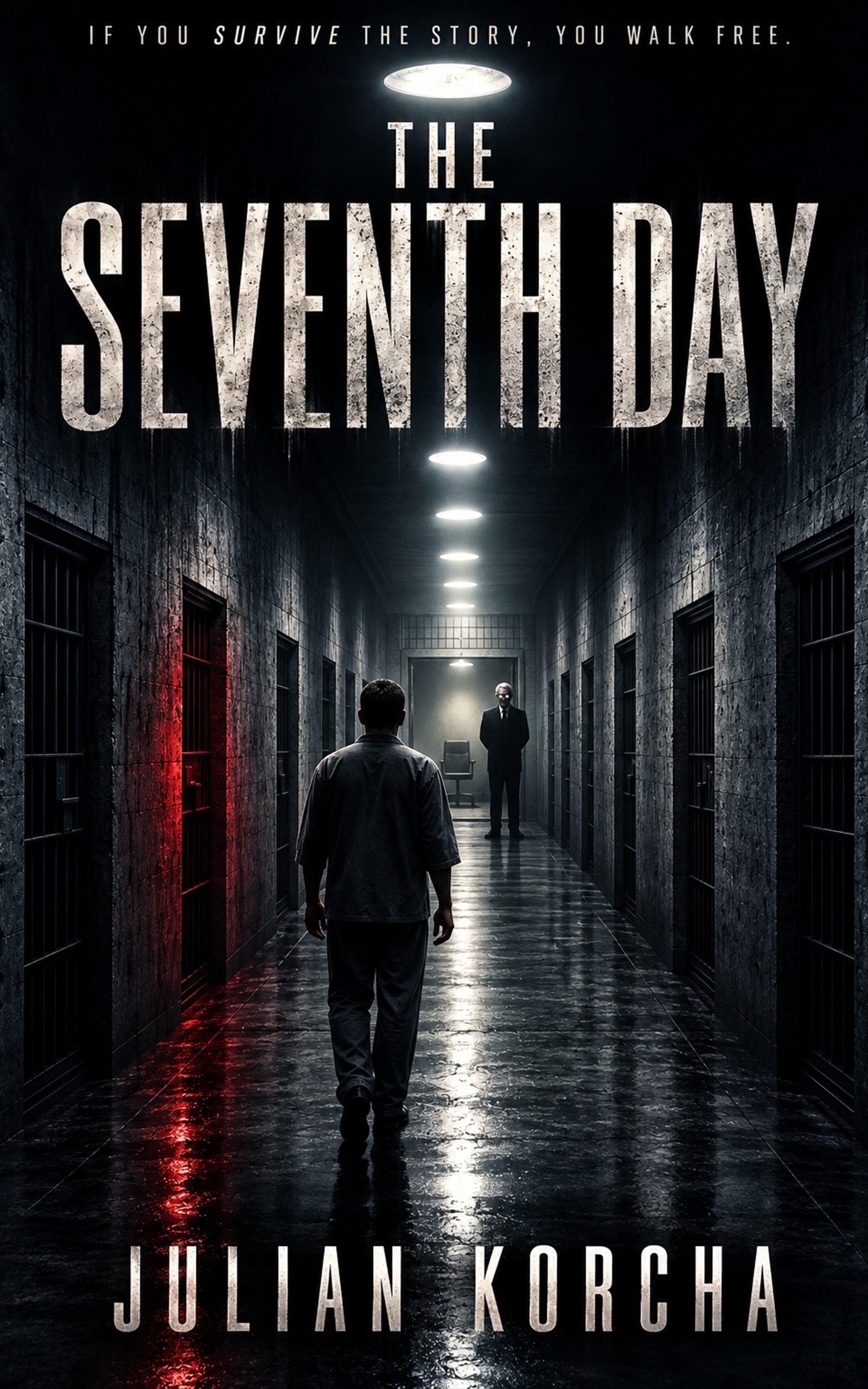
Psychological horror · A standalone novel
The Seventh Day
If You Survive the Story, You Walk Free
On death row, the warden offers every inmate the same deal: survive his story, and walk free.
Enter Harrow Penitentiary, where freedom is written into the rules and death lives between the words.
Your first incident is free
Read or listen to Chapter One.
No signup. No excerpt cut short just as something goes wrong. The complete opening chapter is here.
Chapter One · Audio edition
Arrival
8 minutes · Computer narration by Kokoro · Michael
Chapter One · Free to readArrivalOpen chapter Close chapter
Chapter One: Arrival
The first thing I noticed about Harrow was the quiet.
Not silence — prisons are never silent. There’s always the hum of ventilation, the clank of steel, the distant percussion of doors opening and closing in corridors you can’t see. But Harrow had a different kind of noise beneath the noise. An attentiveness. The sound of men listening.
I’d been transferred from Colfield, where the noise was constant and animal — shouting, banging, the wet impact of flesh on flesh that meant someone was settling a debt or starting one. Colfield was chaos with a schedule. You ate at six, you fought at seven, you slept when your body gave out. The guards maintained order the way zookeepers maintain order: with distance and tranquilizer darts.
Harrow was nothing like that.
The van brought me in at dusk. February. Cold enough that the cuffs bit through my sleeves and the air tasted of iron. The facility sat in the middle of flat farmland — no trees, no buildings, no visual interruption between the prison walls and the horizon. Just dirt and sky and the long gray ribbon of a two-lane road disappearing in both directions. The kind of landscape that makes you understand the word desolate is not a metaphor.
Processing was efficient and impersonal. They took my clothes, my name, my history. Gave me a number, a jumpsuit, a pair of slides that were two sizes too large. A guard named Briggs — stocky, bald, eyes that moved constantly without focusing on anything — walked me through a series of locked doors, each one heavier than the last, each one sealing off another layer of the outside world.
“B-Block,” he said when we reached the final door. “Death row.”
I knew that. I’d been sentenced eight months ago. The transfer was administrative — overcrowding at Colfield, a bed opening at Harrow. The state didn’t care where I waited to die. Neither did I.
Briggs opened the door and the quiet hit me.
B-Block was a corridor. Eight feet wide, fluorescent-lit, concrete floor polished to a dull sheen by decades of institutional mopping. Twelve cells, six on each side, facing each other across the gap — odd numbers down the left wall, even down the right, so that every man lived opposite his neighbor’s number plus one. No solid doors. Bars, floor to lintel, painted the gray-green of old machinery, worn bright at the height where hands hold them. An older architecture than I had expected. Nothing on this row was hidden from anybody, which I would have called a small mercy if anyone had asked, and nobody asks.
But the men inside the cells were wrong.
Not wrong in the way Colfield inmates were wrong — aggressive, volatile, vibrating with the surplus energy of men who had too much time and too little space. These men were still. They sat on their bunks or stood at their bars and they watched me walk the corridor with an attention that felt physical, like hands pressing against my chest. Nobody shouted. Nobody rattled a cup along the iron. Nobody asked who I was or what I’d done or whether I had anything worth stealing.
They watched. They waited. They listened.
Briggs stopped at Cell 7. Unlocked it. Stepped aside.
“Meals at six and five. Yard time between cycles — you’ll learn what that means. Don’t touch the intercom unless it’s an emergency.” He paused. Looked at me with something that wasn’t sympathy and wasn’t contempt. Something closer to apology. “You’ll get the rest from the others.”
I stepped inside. The barred door rolled shut behind me with a sound like a dropped chain. Seven by ten feet. Steel bunk, steel sink, steel toilet. A mattress the thickness of a folded newspaper. A wool blanket the color of cigarette ash.
And on the wall, bolted at eye level beside the door, a laminated card. White, slightly yellowed at the edges, printed in block letters:
IF YOU SURVIVE TO THE END OF THE STORY, YOU WALK FREE. FULL EXONERATION. RECORD EXPUNGED.
I read it twice. The words didn’t change. I touched the laminate — smooth, cool, the edges sealed with tape that had been applied and reapplied many times. The card had been there for years. Decades, maybe.
I lay down on the bunk. The mattress offered the resistance of a wet paper towel. I stared at the ceiling and listened to the quiet of B-Block and thought about the card and the word story and the way the inmates had watched me with the particular stillness of men who knew something I didn’t.
An hour passed. Two. The fluorescent light hummed in a frequency that lived right at the edge of hearing, a dog-whistle drone that you stopped noticing until you noticed it again. I was close to sleep — the thin, shallow sleep of a man in a new cage — when a sound brought me upright.
Wheels. Rubber on polished concrete. A slow, steady rolling, accompanied by the measured footsteps of two people walking in sync.
I went to the bars.
A gurney was moving down the corridor. Two guards pushed it — not Briggs, two others I hadn’t seen, their faces set in the expressionless masks of men performing a routine they’ve performed many times. On the gurney lay a body.
It was uncovered. No sheet, no blanket, no modesty. An inmate in an orange jumpsuit, flat on his back, hands at his sides, face aimed at the ceiling. The fluorescent light washed over him with the indifference of daylight on a parking lot.
His face was frozen. Not the slack blankness of sleep or the settled stillness of peaceful death. Frozen. Eyes wide open, whites showing, pupils fixed on something above him that wasn’t the ceiling. Mouth slightly open, lips pulled back, teeth visible. The muscles of his face contracted in an expression that I recognized immediately and viscerally, the way you recognize a scream before you hear it.
Terror. Pure, absolute, arrested terror. Whatever this man had seen or heard in his final moment had stamped itself on his face like a brand, and the face had kept the shape after the life behind it was gone.
The gurney rolled past my cell. Three feet away, with nothing between us but bars. Close enough to see the fine lines around his eyes, the stubble on his jaw, the precise color of his skin — not pale, not blue, but drained. As if the pigment had been pulled out along with the life.
Close enough to see that his eyes, though fixed and dead, still looked afraid.
The gurney passed. The wheels faded. The corridor returned to its fluorescent quiet.
From across the corridor, one cell down — Cell 6, catty-corner to mine — a voice. Low, flat, devoid of inflection. The voice of a man who has said these words many times and long ago stopped expecting them to help.
“That’s how it works here.”
I pressed my forehead against the bars. The iron took the heat out of my skin and did not give it back.
“What is?” I asked.
“The execution.”
I looked at the laminated card. If you survive to the end of the story, you walk free.
“What story?”
Cell 6 didn’t answer for a long time. When he did, every word sounded selected in advance.
“The warden tells you a story. Takes seven days. One session a day. When he says the last word, you die.”
“That’s insane.”
“Yeah.”
“That’s not — you can’t kill someone with a story.”
“No.”
Another pause. Longer.
“But they’re dead anyway.”
The story
One impossible detail is enough.
Bolted beside every door on death row is a promise: survive to the end of the warden's story and walk free. Nobody has ever collected.
The man in Cell 7 cannot leave a story alone. Every tale rearranges itself behind his eyes. The compulsion that cost him everything may be the only reason he survives—and it will cost considerably more than seven days.
Read on AmazonDo not miss the next incident
Join Julian's reader list.
Occasional release notes and unsettling extras. No daily noise.
Another door
If this one lets you go…

Reality-bending thriller · A standalone novel
The Discrepancy
Nelson stares at a framed photograph of himself and his wife in Paris. He remembers Venice. Everyone else insists it was Paris.